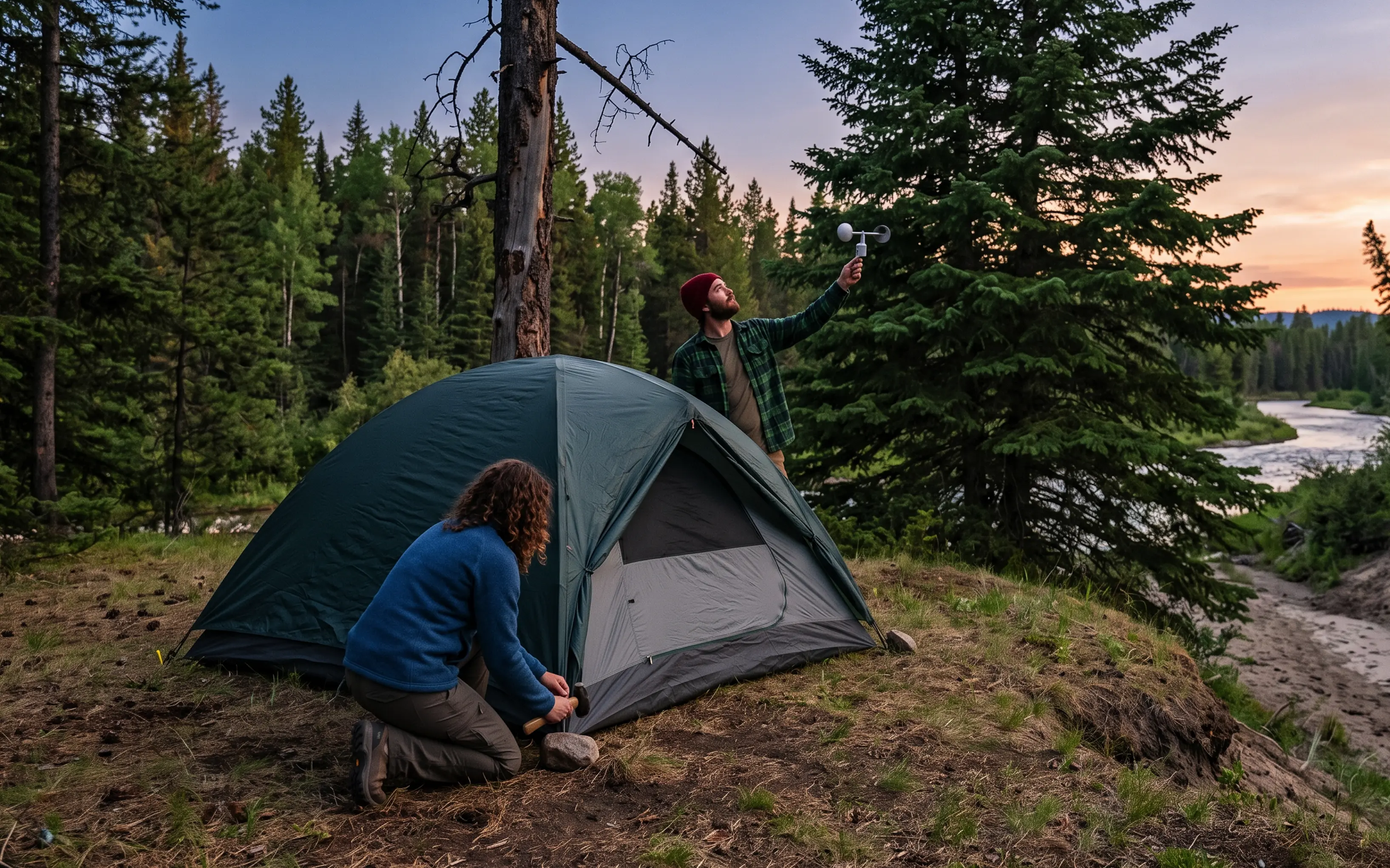
After a long day of hauling a heavy pack up mountain passes, the urge to simply drop your gear and set up your tent wherever you stop is incredibly strong. However, rushing your camp setup is a critical error. The location you choose will dictate your safety, warmth, and comfort for the next 8 to 12 hours.
Selecting the perfect campsite is both an art and a science. Here are the golden rules for pitching your camp in the backcountry.
1. Look Up: Beware of "Widowmakers"
Before you even unroll your tent footprint, look directly above you. A "widowmaker" is a dead, hanging branch or a diseased tree that could snap and fall during the night, especially in high winds. Pitching your tent under one of these is incredibly dangerous. Always choose an area with healthy, sturdy trees or open sky above you.
2. Follow the 200-Foot Rule (Leave No Trace)
To protect fragile ecosystems and ensure water sources remain uncontaminated, you must pitch your tent at least 200 feet (about 70 large steps) away from lakes, rivers, and streams. This also keeps you off the paths of wildlife heading to the water to drink at dusk and dawn.
Environmental Note: Try to camp on durable surfaces like established clearings, rock, gravel, or dry grass. Avoid setting up camp on pristine alpine meadows or fragile vegetation.
3. Analyze Drainage and Depression
Never pitch your tent in a bowl or a depression in the ground, even if it looks perfectly flat and soft. If it rains during the night, water will naturally flow into that depression, turning your campsite into a puddle and soaking your gear. Always look for slightly elevated, convex ground so that water drains away from your tent.
4. Manage Wind and Condensation
Wind can be both your friend and your enemy.
- High Winds: If a storm is blowing in, seek natural windbreaks like large boulders, thick bushes, or a dense grove of healthy trees. Pitch the lowest, narrowest profile of your tent facing into the wind.
- Condensation: In calm, cool weather, sleeping in a valley or near a body of water will result in massive internal tent condensation due to cold air sinking. Pitching your tent slightly higher up a slope where the air keeps moving will keep you much drier.
5. Creating the Sleeping Area
Once you have found the right spot, clear the immediate area of sharp rocks, pinecones, and sticks. Not only will these ruin your sleep, but they can puncture your tent floor and your expensive inflatable sleeping pad. Lay down your footprint, stake out the corners tightly, and ensure the rainfly is taut to prevent flapping in the wind.
Taking an extra 10 minutes to properly scout and pitch your camp makes the difference between waking up exhausted and waking up refreshed, ready for the next day's adventure.